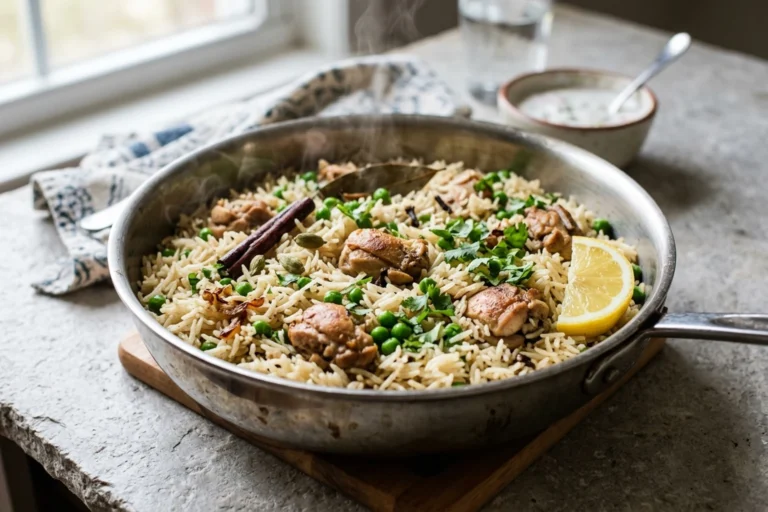
Restaurant-Style Jeera (Cumin) Basmati Rice (Fragrant Stovetop Method)
Master restaurant-style jeera basmati rice at home: perfectly separate, needle-long grains infused with toasted whole cumin seeds, ghee, and warming whole aromatics.
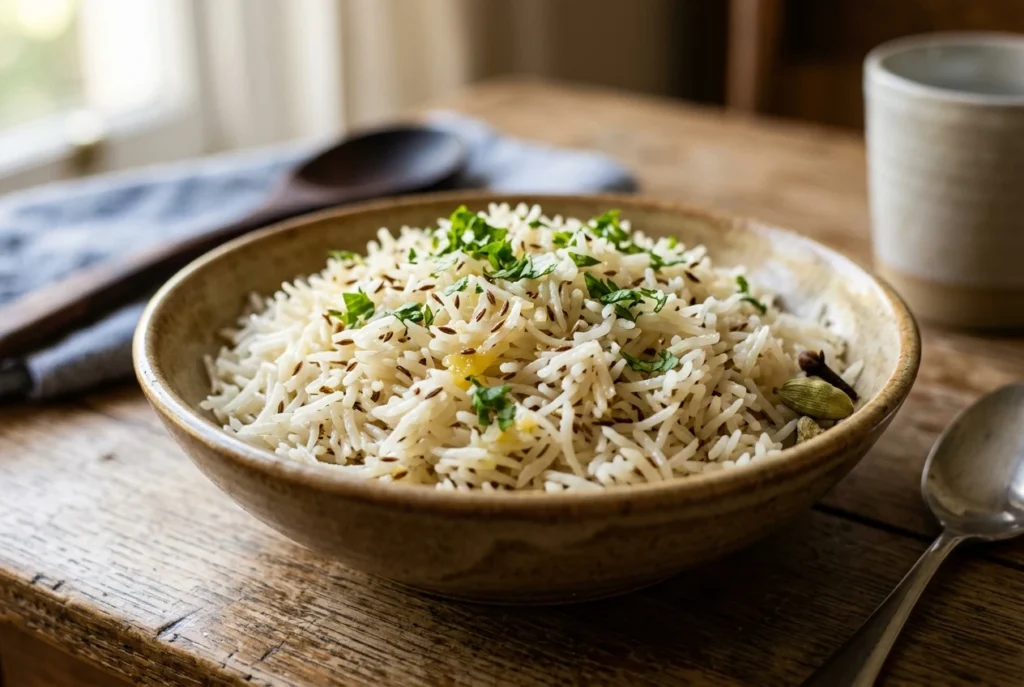
If you have ever wondered why Indian restaurant rice arrives as impossibly long, aromatic, completely separate needle grains that glisten with buttery richness—while home-cooked basmati often ends up sticky, clumpy, or broken—the secret comes down to two culinary techniques.
First, restaurant kitchens never cook unsoaked rice; they give aged basmati a gentle 30-minute cold hydration soak, allowing the inner grain to expand longitudinally rather than splitting laterally. Second, they never dump cumin into plain boiled rice. Instead, they harness the tadka (blooming) technique: toasting whole cumin seeds and warm whole aromatics in hot ghee first, coating every raw grain in fragrant fat before water touches the pot.
The result is Restaurant-Style Jeera (Cumin) Rice: extraordinary grain separation, warm nutty depth, and a buttery fragrance that makes everyday weeknight curries feel like a feast.
Plain Steamed Rice vs. Restaurant-Style Jeera Rice
| Culinary Dimension | Plain Steamed Basmati | Restaurant Jeera Rice |
|---|---|---|
| Cooking Fat | None (simmered in plain water) | Pure ghee or unsalted butter (fat coats raw grains) |
| Aromatics | Rice natural aroma only | Toasted whole cumin, green cardamom, cloves, bay leaf |
| Grain Separation | Moderate; can clump if steam condenses | Maximum; fat barrier prevents surface starches from adhering |
| Active Hands-On Time | 2 minutes | 5 minutes |
| Best Pairing | Everyday yellow dal or soupy curries | Velvety gravies: Butter Chicken, Tikka Masala, Paneer |
The 4 Non-Negotiable Rules for Needle-Length Grains
- Source Aged Basmati (12 to 24 Months): As demonstrated in our Definitive Basmati Rice Brand Ranking, young or cheap long-grain rice has high internal moisture and weak amylose chains that turn mushy. Aged basmati (such as Royal Chef’s Secret or Daawat Ultima) has lost excess water, allowing grains to swell lengthwise up to 2.5 times their dry length without breaking.
- The Gentle 3-Rinse Cold Wash: Measure rice into a mixing bowl, submerge in cold tap water, and gently swirl with your fingertips for 15 seconds. Drain through a fine-mesh strainer. Repeat 2 to 3 times until the water turns mostly clear. Crucial caution: Never rub raw grains aggressively between your palms; aged basmati is brittle when dry and will snap in half.
- The 30-Minute Hydration Soak: Soak the rinsed rice in cool water for 20 to 30 minutes on the counter. Soaking hydrates the grain’s starch core evenly before boiling. When hot water hits a soaked grain, it expands uniformly along its length rather than splitting open or curling.
- The 10-Minute Off-Heat Steam Rest: Once the 10-minute simmer completes, do not open the lid. Remove the pot from the burner and let it rest undisturbed for 10 full minutes. The trapped residual steam redistributes moisture evenly from the bottom to the top of the pot. Always fluff gently with a dinner fork—never use a wooden paddle or flat spoon, which shears delicate grains.
Calibrating the Water-to-Rice Ratio
Cooking soaked basmati requires slightly less liquid than unsoaked rice because the grains have already absorbed approximately 20% to 25% of their weight in water during the soak.
For well-drained soaked basmati cooked on a residential gas or electric burner with a standard tight-fitting lid, 1.75 cups (14 fl oz / 420 ml) delivers perfectly tender, distinct grains. If your saucepan lid has a wide steam vent or fits loosely, use the full 1.75 cups to compensate for evaporation. If you are using younger supermarket basmati (like Trader Joe’s or store-brand), start at 1.5 to 1.6 cups to ensure the grains stay firm.
Ingredients & American Pantry Swaps
- Aged Basmati Rice (1 cup / ~200g): Look for labels marked “Aged 1 to 2 Years” or “Extra Long Grain” (see our Basmati Brand Guide for Costco and supermarket options).
- Ghee or Unsalted Butter (1.5 tablespoons): Pure Indian clarified butter (ghee) provides the signature nutty restaurant aroma and high smoke point. Pantry swap: Unsalted butter, or avocado/coconut oil for a 100% vegan side dish.
- Whole Cumin Seeds / Jeera (1.5 teaspoons): Fresh, fragrant whole cumin seeds. Never use ground cumin powder, which turns the rice a muddy brown-grey and creates a grainy texture.
- Whole Warming Aromatics (The Restaurant Signature):
- 2 green cardamom pods: Lightly cracked with the side of a knife so the aromatic black seeds can perfume the ghee.
- 2 whole cloves: Imparts subtle warmth without bitterness.
- 1 Indian bay leaf (tej patta) or Turkish bay leaf: Indian bay leaves (cinnamomum tamala) smell sweet and cinnamon-like; Turkish bay leaves provide herbal depth.
- 1/2-inch cinnamon stick (optional): For festive, dinner-party depth.
- Fine Kosher Salt (3/4 teaspoon): Salt Calibration Note: If using salted butter instead of ghee or unsalted butter, reduce the salt to 1/2 teaspoon.
- Fresh Lemon Juice (1/2 teaspoon): A classic restaurant secret. A tiny squeeze of lemon acid keeps rice grains brilliantly white and reinforces starch firmness. It does not make the rice taste sour.
- Water (1.75 cups / 420ml): Filtered tap water.
- Fresh Cilantro (2 tablespoons, finely chopped): Tossed in right before serving for color and herbal lift.
In traditional Indian cooking, whole spices (the green cardamom pods, cloves, and bay leaf) are bloomed in hot fat solely to perfume the cooking liquid. They are not meant to be eaten or chewed. Biting down on a whole clove or cardamom pod releases an intense, numbing burst. Simply spot them with a fork and lift them out before serving, or push them to the rim of your plate.
Step-by-Step Stovetop Instructions
Step 1: Rinse and Soak (30 Minutes, Hands-Off)
Measure 1 cup of basmati rice into a bowl. Cover with cool tap water and gently swirl with your fingers for 15 seconds. Drain through a fine-mesh strainer. Repeat twice more until the water is largely clear. Refill the bowl with cool water and let the rice soak undisturbed on your counter for 20 to 30 minutes. Drain thoroughly in the strainer for 2 minutes to remove excess surface water.
Step 2: Bloom the Whole Spices (2 Minutes)
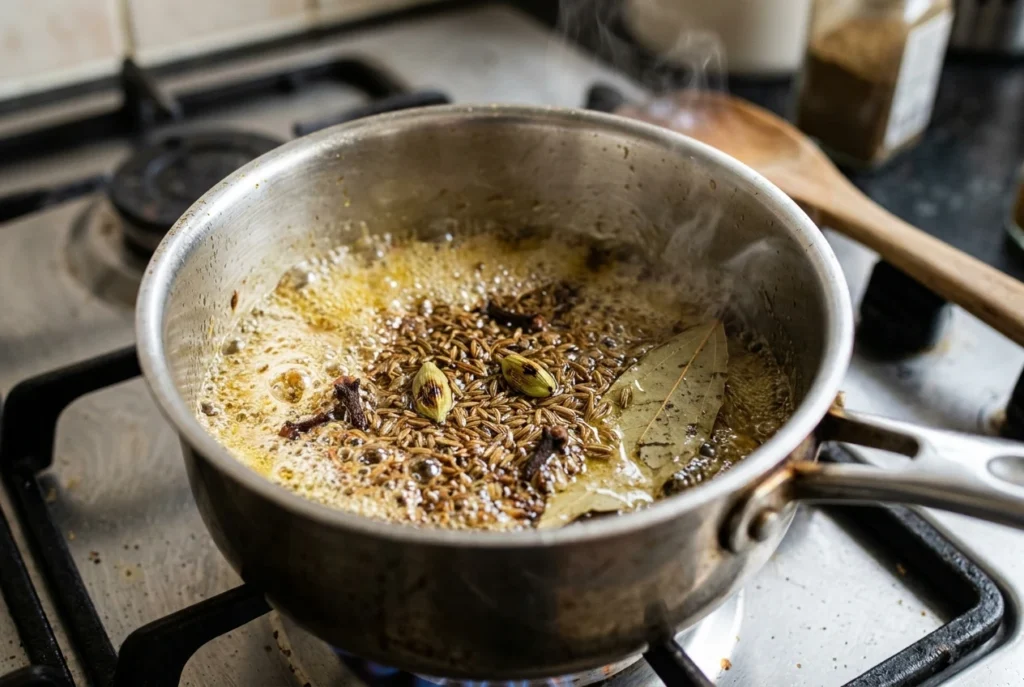
Place a heavy-bottomed 2-quart saucepan or Dutch oven over medium heat. Add 1.5 tablespoons of ghee (or unsalted butter). When the fat melts and shimmers, add 1.5 teaspoons of whole cumin seeds, 2 cracked cardamom pods, 2 whole cloves, and 1 bay leaf.
Let the spices sizzle and dance in the warm fat for 45 to 60 seconds. The cumin seeds will darken to a rich golden brown and release a fragrant, toasted aroma. Do not let the cumin turn dark black or smoke.
Step 3: Toast and Coat the Grains (1 Minute)
Turn the heat down to medium-low. Add the thoroughly drained basmati rice to the saucepan. Using a gentle silicone spatula, fold the rice into the warm spiced ghee for 60 seconds. Every single grain should be glistening with fragrant fat, which seals the starch surface and ensures complete grain separation.
Step 4: Add Water and Simmer (10 Minutes)
Pour in 1.75 cups of water. Add 3/4 teaspoon of kosher salt and 1/2 teaspoon of fresh lemon juice. Stir gently once to distribute the seasonings.
Raise the heat to medium-high and bring the pot to a vigorous rolling boil. Once the water level drops to the surface of the rice and large steam craters appear (about 2 minutes), immediately reduce the heat to the absolute lowest setting and cover tightly with a secure lid.
Simmer undisturbed for 10 minutes. Do not remove the lid or stir.
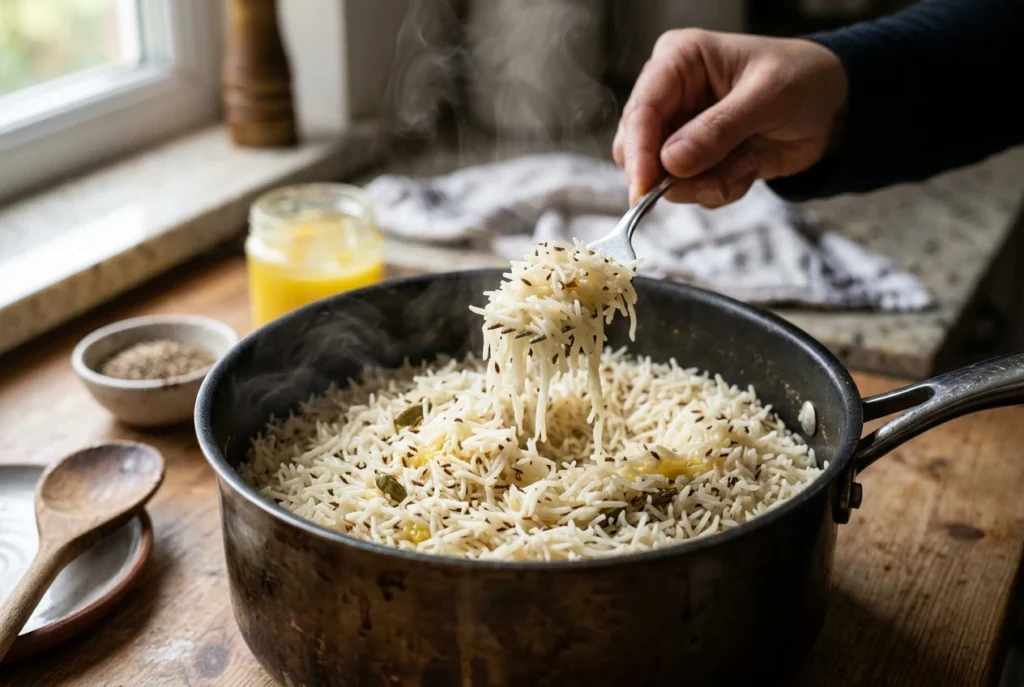
Step 5: Rest and Fork-Fluff (10 Minutes)
Slide the pan completely off the heat onto a cool burner. Keep the lid firmly closed for 10 minutes. This resting stage allows the trapped vapor to equalize throughout the pot.
Remove the lid. Discard the bay leaf, cardamom pods, and cloves if desired. Scatter 2 tablespoons of chopped fresh cilantro over the rice. Take a regular dinner fork and gently rake through the grains from the outer perimeter toward the center. The basmati grains will tumble apart into long, fluffy, distinct needles. Serve hot.
Instant Pot / Pressure Cooker Variation
If you prefer using an electric pressure cooker, adjust the water ratio slightly to account for zero steam evaporation:
- Ratio: 1 cup soaked and drained basmati rice + 1 cup water + 1 tbsp ghee.
- Method: Set Instant Pot to
Sauté [Normal]. Melt ghee, bloom cumin and whole spices for 45 seconds. Add drained rice and stir for 30 seconds. Add 1 cup water, salt, and lemon juice; stir once. - Cook Time: Lock the lid, set steam valve to
Sealing, and cook on High Pressure for 4 minutes. - Release: Allow a 10-minute Natural Pressure Release (NPR), then carefully release any remaining steam. Remove the lid, add cilantro, and fluff with a fork.
Scaling Guidance
This recipe doubles effortlessly:
- 2 Cups of Rice: Use 3.25 to 3.5 cups of water and 2 tablespoons of ghee in a 3-quart or 4-quart pot. Simmer time remains 10 minutes on low heat with a 10-minute rest.
- 3+ Cups of Rice: When cooking larger batches, use a wide 5-quart Dutch oven rather than a deep, narrow pot. A wide surface area prevents the weight of top grains from crushing bottom grains into mush.
What to Serve with Jeera Rice
Restaurant jeera rice is the universal foundation for flavorful Indian entrees:
- With Weeknight Curries: Spoon this under our new 15-Minute Skillet Butter Chicken (Rotisserie Shortcut) or our Rao’s Marinara Tikka Masala Hack.
- With Warm Flatbreads: Pair alongside top-rated flatbreads from our Store-Bought Naan Brand Ranking.
- Balancing Heat: If serving with spicy dishes, check our Spice Level & Heat Translator and pair with a side of cooling cucumber raita.
Common Troubleshooting
- Why did the rice turn sticky? Skipping the cold water rinse leaves powdered surface starches that gelatinize in water. Skipping the 30-minute soak forces the outer grain to overcook before the center is tender.
- Why is the bottom of the pot scorched? The heat was not turned to the lowest possible setting during the 10-minute simmer, or the saucepan bottom was too thin. Use a heavy tri-ply saucepan or cast-iron Dutch oven for even heat dispersion.
- Why did the rice turn dry or crunchy? The lid fit too loosely, allowing steam to escape, or the rice was boiled on high heat for too long before covering. If rice seems slightly undercooked after resting, sprinkle 2 tablespoons of boiling water over the top, cover, and rest on low heat for 3 minutes.
Frequently Asked Questions
Can I use brown basmati rice for this recipe?
Brown basmati retains its fibrous bran layer, requiring more water and longer cooking. If using brown basmati, soak for 45 minutes, increase water to 2.25 cups, and simmer on low for 40 to 45 minutes with a 10-minute rest.
How do I reheat leftover jeera rice without drying it out?
Store cooked jeera rice in an airtight container in the refrigerator for up to 4 days. To reheat, sprinkle 1 to 2 tablespoons of water over the rice, cover loosely with a damp paper towel, and microwave in 45-second intervals. Alternatively, warm in a covered non-stick skillet over low heat with a tiny dab of fresh butter.
Can I freeze cooked jeera rice?
Yes. Cool completely to room temperature, portion into freezer-safe ziplock bags with air pressed out, and freeze for up to 2 months. Reheat directly from frozen in the microwave with a sprinkle of water.
15-Minute Butter Chicken →
The ultimate velvety curry partner for freshly fluffed cumin basmati rice.
Basmati Rice Brand Ranking →
Check out which supermarket basmati brands achieved top grain length and aroma.
The Recipe Card
Development note: This recipe was developed from culinary research and established cooking methods. Unless this page explicitly says otherwise, TrendyTadka has not physically cooked or tested it; times and results should be treated as estimates. Read our complete methodology.
Keep Cooking